About Us

Welcome to our blog of our 2013 trip. We Have been camping since our honeymoon. Each summer we take a trip to a new part of our country. We try to stop at local fairs & festivals, take tours of manufacturing plants, do a little kayaking, and try to get an up close look at how people live! Join us! This Bog runs from our most recent post backwards. At the end of this year,I have left the past years blog. Double click on any picture to get a larger image. These are all low res versions. If you see one you really like, let me know and I'll send you a better image.

Liz & Bruce on the way to Minnesota, last year

Friday, July 22, 2011

Sunday Aft. July 17


Sorry, I got my order mixed up a little. On Sunday afternoon we went down to the southern part of Lake Champlain, to the Lake Champlain Maritime Museum. Liz and I continue to marvel that we're not running into any crowds. We're not sure if that is because we're where there aren't any vacationers or if it's just that our tastes are different. Regardless, it is very pleasant. This museum was again sparsely attended, but very well done. It was miles from the main highway which probably accounts for the attendance.
We started off with a demonstration of the original 1 or 2 horsepower ferry. This staffer is standing on a turntable that goes underneath the deck of the boat. They would have one or a pair of horses walk on the turning table. Needless to say it was quickly replaced by the steamboat.
They had a benefactor who was really into Ice Boating. He found this 1902 ice boat in shambles somewhere, restored it, and started taking it out on the lake in the winter. He rejuvenated ice boating, and sailed her for a number of years, before donating her to the museum. The museum created a building especially for her, and surrounded her with over 90 small craft, from dug out canoes to modern Kevlar kayaks.
We continued our education on the role that Lake Champlain played in our Independence. We had already heard the story of how Benedict Arnold, cornered in the northern part of the lake, by the British, was destined to be be captured with all of our nations lake boats. He hatched a plan to silently paddle his boats around the British boats in the dead of night. He made it almost down to Ft. Ticonderoga, when the British caught up. Arnold landed and escaped with his crew, burning his boats, behind him. He left a small group of soldiers, with orders to fabricate a bridge across the lake during the winter. This they did by assembling caissons out of 25 ft long timbers then filling them with boulders. The guy in charge only kept some records so there is no history as to how this was accomplished. They theorize the men took everything out on the ice, stacked it up and then sunk it section by section. They admit it doesn't make much sense, but that is all they can think of. When spring came, Arnold and his troops were back, and they successfully fought the British, and due to this bridge they defeated them with very little in the way of marine strength. The bridge footings are all still there, save one which was destroyed for commercial travel. This timber floated to the surface, and was recovered.

We had heard the stories of the gunboats that Arnold constructed and used during his battles on the lake. I imagined them to be large sailing ships, but they were not. They were built quickly and very simply. They were little more than a floating barge under sail with a large contingent of cannon on board. The museum recreated the gunboat Philadelphia, pictured here. Besides the two cannon your can see here, there were 4 other, 2  on each side. There were also 44 men on board. Nothing below for quarters, simply open deck to sleep on. Not exactly a cruise! they have found another under the surface and they are raising funds to raise her!

Tuesday, July 19, 2011

Weekend of July 15-17

We moved over to Burlington for the weekend. we found a little park on Mallets Bay, part of Lake Champlain. We've got lots of things to  do and see here, from a few factory tours, to museums.
We'll stay until we hit the ones that interest us most.
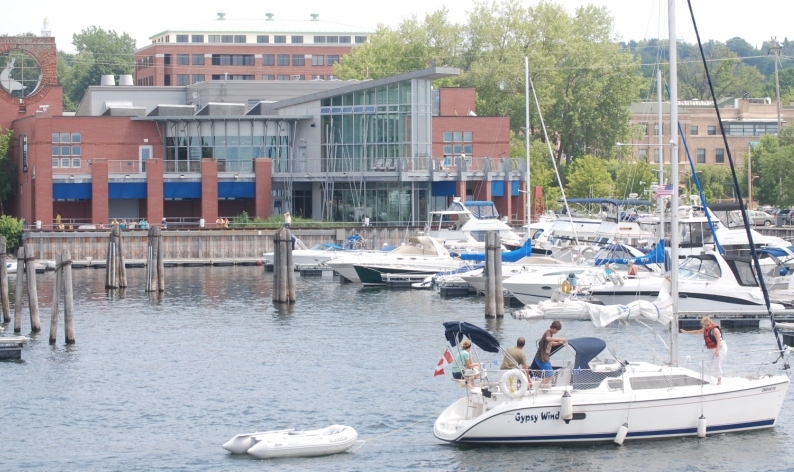
We started off with a walk down by the bay in the evening on Friday, (while our laundry was in the machines), Very pleasant, nice breeze, beautiful boats.

On Saturday we went to Burlington's aquarium, and ecology center, ECHO. It is the Glass window structure in the center. This is a  nicely done aquarium, showing marine animals from Lake Champlain. Here we began to hear the story of Lake Champlain and the crucial part the battles during 1776-7 played in our country's independence. ECHO had a beautiful little cafe, and we took our lunch out on the patio on the waterfront. The weather was warm, but not unpleasant because of the breezes off the lake. We watched ferries and tour boats come in and out.
After we left ECHO, we went across to a ship the Lake Champlain Maritime Museum recreated, the Lois McClure. She is a sailing canal Schooner, described as a 19th century "18 wheeler". These were flat bottomed narrow boats made to be loaded with coal, marble granite, timber, or what ever needed to be transported.
. They were operated by individuals or sometimmes families.
Here is the area in the stern below deck, where a family would live. There were two additional bunks in the bow. This boat was built by the museum as a floating exhibit and it spends some time here in Burlington, and also down at their headquarters in Vergnennes VT
On Sunday we went back to this area, and boarded the Northern Lights, kind of a recreation of an old steamboat that used to work the lake carrying passengers and freight . This was a combination lunch cruise, and before we left dock we began to hear from a local history teacher who would be our tour guide. He was very good at telling the history of Lake Chaplain region. When he got to the story about Benedict Arnold and the fall of 1776 you could tell this was where his interest lie. He described the lakes importance, the struggles both the colonists and the British had in equipping themselves with ships, and especially the importance of Arnold.
Up here in Lake Champlain country, they recognize that Arnold did not finish his military career with glory, having changed sides. But they recognize the battles he won and his courage in technique. Like Bennington, where we just were, people here believe this is the place where the colonists fought the crucial battle that set the new nation up for the big win in Saratoga the following Spring.
The cruise took us by some of the geology of this region and  our history teacher guide turned into a more than adequate Geology teacher. He described the collision between the two continental plates that formed the Adirondack mountains to our west, the lake we were on, and the Green mountains to our east.

This is really quite a geologists dream landscape, because  of the difference you can see in the rock, representing completely different formation, time,and distance traveled. The display we saw the day before in the museum highlighted how the land around the lake was once much lower, allowing it to actually become a part of the Atlantic oceean. They actually have skeletons of Beluga whales that were recovered from this area. when the glacier melted, the land "bounced back" and the lake then became freahwater.

Just outside the breakwater, we were told about a canal schooner the General Butler, that sank, and that is now an interesting dive site. It is the yellow buoy. This lake, while not as large as any of the great lakes has an equal potential for disaster for captains. Storms can develop from the west, and a boat can become in trouble very fast. This happened to the schooner, and the captain headed for Burlington. As he neared it, he ran ground. Then the waves came crashing around the boat raising it up, then bringing it down on the breakwater, repeatedly. He managed to get everybody off, but then they were all huddled on the rocks, in near freezing weather. The harbormaster, seeing all  of this, got in a life boat and rowed out and rescued them.
One last highlight from the cruise, this Coast Guard station. Because Lake Champlain is mostly pleasure boating today, the coast guard has little to do in the off season. Thus this stations designation, "Vacation Station"

Sunday, July 17, 2011

Thursday, July, 14

People sometimes ask how we choose what we do when we're on the road. We're always interested in a good local fair, especially if it has a unique theme like the balloons, or food such as the cherry festival. We like small town parades. We generally avoid a tourist destination, opting instead for out of the way places where the people will take the time to really explain why their facility is important and answer our questions.

American Precsion Museum, is one such place. It is housed in an old New England mill building, and is devoted to the preservation and explantion of a momentous concept in our history. The idea that guns (Products) should be made with standard parts, mass produced and interchangeable. This new process began here in New England, by a number of gun producers. This museum reports that Eli Whitney has lots of competition from a number competing gun producers for the ownership of the idea. They do an excellent job of showing the machine tools that the gun producers used. Then demonstrated to us the other products that benefited from the concept of interchangeable parts, from typewriters to cars, and almost every product that is manufactured.
While this museum is devoted to the concept of interchangeable parts, we started off with a miniature representation of custom made work. A German immigrant built models of common machine tools, boring machines, lathes, mills, etc. 1/16 size. Yes those are standard size bricks in the background. He built these and stored them in his parents house in Germany. He came to the US, and then after the war, returned home and found his models preserved by his parents, brought them to the US, and began to work on more. They had 30-40 of them, each one a representation of precision.
They had an example of every type of machine tool that would be in shops. the one pictured here is a lathe, made for turning cylinders.
They also had a more modern machine shop in the center staffed by a young intern, who was a student at a local trade school. Here he demonstrated various machines for us, making a wine glass for Liz smaller than her thumbnail. Nicely done.
We stopped and ate in the Windsor Diner a little roadside dining car produced by the Worcester Diner Car Co. Left the camera in the Truck.


We headed off to the Simon Pearce Glassblowers. I had no idea what to expect, but the guidebook said they offered glassblowing and pottery making demonstrations. We started off at their headquarters location, which had a store showing their pottery and glass. Looked very nice, very durable, and veeerrrry expensive. But we persevered.
They had a video running in the store where Simon told the story of how he began making pottery in his fathers shop, studied throughout Europe, and moved to America in 1981. Those of you who were with us last year when we found Marika's dairy, and Gouda cheese shop will see some similarity here. Simon, like Marika, found that despite succsess selling his pottery and glass, the laws and taxes in Ireland were too restrictive. He came to America to find a place where he could build a glass making and pottery, in a nice little community, beautiful scenery, like home, and be self sufficient in energy costs. He came to Queeche VT.
We toured the pottery. He has about 20 potters throwing, molding and building his dishes, bowls and other pieces of pottery. They allowed us out on the shop floor to walk around and ask questions of the potters. As we chatted , I found myself beginning to admire Simon for the way he ran his company. He was in the video saying all the right business jargon, but I've been on enough factory floors to know that a lot gets lost between the CEO's office and the shop.I was starting to like this guy.
They weren't blowing glass at this shop. because a furnace was down for repair, but everybody said we had to see the Queeche facility, 20 min north. so we did. This is actually the back of his shop. It shows the beautiful restaurant he built over the river, with his shops selling the glassware and pottery in the brick building behind, where the people are standing.
In the wood building is the glass blowers, and below that his power plant. Here is the Generator he put in. They had to excavate from where I'm standing down to the bottom of the generator you see here, and then go another 30' below that for the sluice way. this was a major project! He originally sold all the power back to the power company but later on as he grew, he decided to consume it, and sell any excess. The permits to do this cost him $750,000!!! He still persevered. I was really starting to like this guy, because he was not just saying all the right things he was actually DOING them! Just above the generator room was his glassblowing shop, where he had artisans making Christmas ornaments today. We were told he has shops selling his products in most major cities in this country, and a similar facility to the Queeche plant complete with river, and generator for power in PA. and a very large pottery shop in an old Bausch & Lomb plant in Md. He has to employ hundreds of people. This is one way to create employment in America

Wed. July 13

Wednesday found us heading towards the Calvin Coolidge Birthplace, via the Vermont Marble Museum. Marble and Granite have always been associated in my mind together, and with Vermont. Those of you who are back from prior years know that Liz is our geologist, and I learned that Marble is formed differently than granite. First of all marble is limestone that has been compressed over time with two of the big forces on earth, heat and pressure. Granite, as I’ll learn next week is basically lava. Marble has incredibly compressive strength, as you can tell, by enlarging the picture of the entrance to the Museum. The very large pieces of Marble are being held in place by the little pieces in between. It is very durable, but cuts and polishes well, and is a natural material for important buildings, because certain veins of marble have high degrees of luminosity, sparkle, color or other characteristics that suit architects well. Marble can be cut and shaped easily as evidenced by all of the sculpture we’ve seen, like the owl pictured.

The Vermont Marble museum is in the former plant of the Vermont Marble Co, in Proctor. Proctor was named after it’s founder, Who was appointed as the receiver of the company after a number of previous owners failed. Proctor was a frugal man who put all of the company’s earnings back into the company, and he quickly acquired most of the other marble companies in the US. This is quite an accomplishment when we discovered that marble is found in most of the 50 states, An architect changing his mind from a pink shade of white marble to a green shade, may in reality change the location of the marble quarry by thousands of miles. Proctor, by owning them all, could provide a “full service” marble company.

Almost everyone knows that the marble used in the tomb of the unknown soldier is white marble. We learned that the marble was actually quarried by Proctors company in Colorado, shipped by rail to Proctors workshop in VT then shipped to Washington for final work.

Much of the town is built out of buildings made of marble including bridges, most commercial, government buildings, and even the firehouse! ( I don’t know what happened to the second floor!).

Vermont Marble Co. is still operating in VT, all though they are no longer the nation’s largest company, as they were in the beginning of this century.

From there we travelled to a Vermont State historical site, the birthplace of President Calvin Coolidge. Liz’s dad was born a couple of years into Coolidge’s term and was named Calvin Coolidge Miller in his honor. He, like the President was a quiet, simple man who loved the “hills” he was born in.

Coolidge’s family had lived in Plymouth NH for generations when he was born in the back of the country store his dad operated, pictured here. We received almost a personal tour, moving from there to the house where he grew up, across the street. Coolidge went to college in Massachusetts, became a lawyer, then the governor of Mass, before becoming Harding’s VP.

Coolidge was back home in the mountains visiting his parents when the general store receive the 2AM phone call that President Harding had died in CA. Coolidge needed to be sworn in, and, his father being a notary public assumed the honor. He swore his son in as President at 2:30 in the morning- then everybody went back to bed.

The next morning Plymouth became famous, and people came for mile to see where the President was from. The little restaurant across the street actually bought 3 pre-fab cabins, and set them up to rent to the tourists.

Coolidge’s son John, became a successful investment banker. Knowing his Dad stood for a type of old fashioned hard work ethic, integrity, and uncomplicated ways, that was disappearing ,bought up the town as buildings became available. Virtually all of the pieces on display were Coolidge's, and were given by his son. He then gave it all to the state of Vermont for this site, probably 8-10 buildings.

Liz and I were both left wondering what has happened to our political leadership today. We are miles away from the citizen leaders our founders and their successors contemplated. It would be nice to return.

This last photo outside the Coolidge store, is a remembrance from my childhood.When I was small I had a handmade, (by my uncle) Gulf Gas station, and a box full of toy cars. It had all of the detailed decals, including their signature which I loved to repeat. "Good Gulf Gasoline! This one's for a reader in FL, my Dad!

Saturday, July 16, 2011

Tuesday July 12

We’re in Springfield Vt. kind of centrally located on the east side. We’ve drawn a circle around here, and we’ll stay here for a few days.

On Tuesday we headed toward Weston, the home of the Vermont Country Store. On the way we passed Okemo, and decided to see what the base of the ski resort looked like in the summer. Here it is. Note IT's a ways up the mountain! We found a road that would take us all the way to the top of the mountain. We passed the base and numerous ski lifts, each with long strings of chairs climbing up the mountain. None went all the way to the top, each dropping skiers off at intermediate spots for skiing, or transfer to another lift for further ascent. Those of you who are skiers will not be surprised by any of this, but our experience is limited to very small ski resorts in Ohio and a trip up to Burlington to see friends years ago.

We continued up the mountain, past numerous condos and places where the road went right underneath the chair lifts. As we got up to around 2,000-2300’ the signs said that we were in Okemo State Forest. The highest we could get by truck was 3200’ where we turned around, and headed down. I shot this shot at the next lookout, a couple of hundred feet down. When the road crossed a ski path, or under a lift run, we’d each look out our side of the truck and exclaim something like “OH MY that’s steep” or a reasonable facsimile. We realized what babes we are when it comes to skiing these days. At any rate the view from the top was magnificent. It was a great unplanned diversion.

We continued on to Weston. This where the Ortens started their country store. Their kids have turned it into a mail order powerhouse of all things old and long thought no longer made. It consists of the original old country storefront, and a considerable number of out buildings out back in a long string. I surmise these were probably old warehouse and shipping facilities as the business changed from satisfying the residents of Weston to the population of the US. They are now all part of the store.

This is now a destination, with a very large parking lot in the back, and a place for lunch next door. Mildred was the founder’s wife, and the food was excellent. We had a fun time sampling the old soda’s, and people watching folks from all over the country.

As we ate lunch, we realized that the goods this store offers are more than just a glimpse into the past. It’s products offer value to not only elderly people, but also those who have disabilities of any age.

On the way home we wanted to stop at Crowley Cheese, Vermont’s oldest continuous cheese maker. I had called and they assured me they would be making Cheese all day. We got there around 3, and found that their day had just ended. It was in the mid 80’s, and they were hot. They make a different type of Cheddar, what they say is a cross between Cheddar and Colby. We sampled some and loved their extra sharp cheddar. We’re using it in lot’s of great ways. This IS the entire cheese making facility. They say that Cabot (we'll visit next week) makes 100,000 lbs. a week. Crowley makes 100,000 lbs in a great year. They are now owned by a young couple who thought it would be fun to own a cheese maker in Vermont. Apparently from the awards they've won at places that know cheese, like Wisconsin, they are doing it right.

Friday, July 15, 2011

Sunday, July 10 and Monday, July 11

On Sunday we moved over to So. Vermont. We are staying at Tree Farm Campground, a private park. It has all the amenities for around $30 a night. It is in a very old pine forest, with extremely tall trees. The park is so quiet, I think we could go for a day without seeing anyone else here.

On Monday we went down to Bennington, a place I had been quite often during my career at Delker/Dexmet. We found the Energizer plant I sold to, but we were headed to the Grandma Moses exhibit at the Bennington Museum.

The museum was really two in one, Grandma Moses’ paintings, and a rather eclectic collection of some really interesting artifacts from old Vermont and Bennington in particular. First Grandma Moses. I was really uninformed about her, thinking she might have been a “caricature “ or something. I found out she was actually a person, who spent most of her life in New York, not far from Bennington. She took to “art” lat in life starting out with fabric pictures’ and only adopting paints as her media later. She was said to have painted in the Primitive style. They had many of her paintings, and many other pieces from her life. They did a good job of showing the whimsy, and the progression through her paintings, but something seemed incongruous to me. It caused me to ask a guide how the Bennington museum managed to acquire all of these pictures and other things from her life. She had only been associated with Vermont for a very short period of time. I got a rather non communicative answer. It turned out that New York considers her to have been “hijacked". VT even has her One Room Schoolhouse. She had a “manager” who promoted her work, made her familiar with copyright laws, and seemed to take good care of her, to the stereotypical guy who takes advantage of a “bumpkin. She seemed wise in the way that we think of wise farmers and mountain people.

The Museum was several steps above the usual “town museums” we are fascinated with as we tour around. They can range from a glorified presentation of everybody’s attic, to a well curated theme of the towns history. This one was the latter, showing a well thought out and presented selection of artifacts from all the skills and professions that made up a small New England town. There was even the last surviving Wasp automobile. Wasps were cars built in the 20’s during the period when car makers flourished, assembling cars with components manufactured by others with unique designs. Wasps were luxury cars costing $10,000 , and available in a half a dozen body styles. This last one was in the process of being built for a customer who died before the car was finished. The company folded and the frame was purchased out of the plants assets. It was driven around town for awhile (just the frame!) and then left to rot. A guy in the Midwest remembered the Wasp, bought the frame and then proceeded to fabricate the rest of the car. He drove it around the country to shows for a few years, and then gave it to the museum. The car needed to be taken apart ande reassembled in the room it’s in at the museum.

Bennington was the site of a major Revolutionary war battle, that was the beginning of the end for Britain. The citizens built this monument to the soldiers, and it gives a great view of three states, and the Green Mountains.

The gear heads among our followers also know Bennington as the home of Hemmings Motor News, and it’s various spinoffs. Unfortunately, I didn’t read our guide book carefully and the museum closed at 3, not 5. They still operate a gas station, with full service in a 40’s setting.

Only thing modern is a Green Mountain Coffee shop inside, and the prices.

Thursday, July 14, 2011

July 8-10

On Friday the 8th we moved to Seven Maples Campground, a nice little park, nothing special. We are finding Vermont Parks to be similar to other parks in New England. Firstly the State Parks have no electability, and are extremely tight, even for us with our short trailer. It's just not worth it for us. That leaves us with the relatively few private parks, which are more expensive, & also generally tight for even our rig. While the park we just left was nice enough, the road to the dumping station was so tight we decided not to dump until this park. Don't get me wrong the parks we have found so far are fine, just much different than the midwest.

On our last day in So. NH, we went to the Hillsboro balloon fest. This festival has been held for the past 23 years, and was once MUCH bigger with 5X the current 10 hot air balloons. Unfortunately we didn’t see any balloons go off. The wind was just too stiff. Here is the basket to the Irish Rover. They were able to launch the three morning launches, but those take place at 6:00AM. We are on vacation, so we missed those. They did have skydivers who gave a great show, and because this is a very small festival we got up close.Hillsboro is in the White mountains, so not only is flying a challenge, but you can imagine that skydiving isn’t easy either. They really have to thread a needle to come down through the "notches". The skydiver here, is a member of the Army, has done countless jumps, and is an instructor for the company doing the demo. As he packed his chute he described the process to us. It was very interesting, and he was an excellent teacher.

This fest is held combined with the Hillsboro Fire Co. muster. We didn't stay for it, but we did eat at thier trailer, and bought some raffle tickets for a Weber grill with their Fire company decal on the front, very cool.